When starting as an IPTV reseller, one of the first decisions you'll face is which server to use. Trex and Dino are two of the most popular choices — but they serve different markets and have significantly different pricing. Here's an honest, detailed comparison so you can make the right decision for your business.
Quick Overview
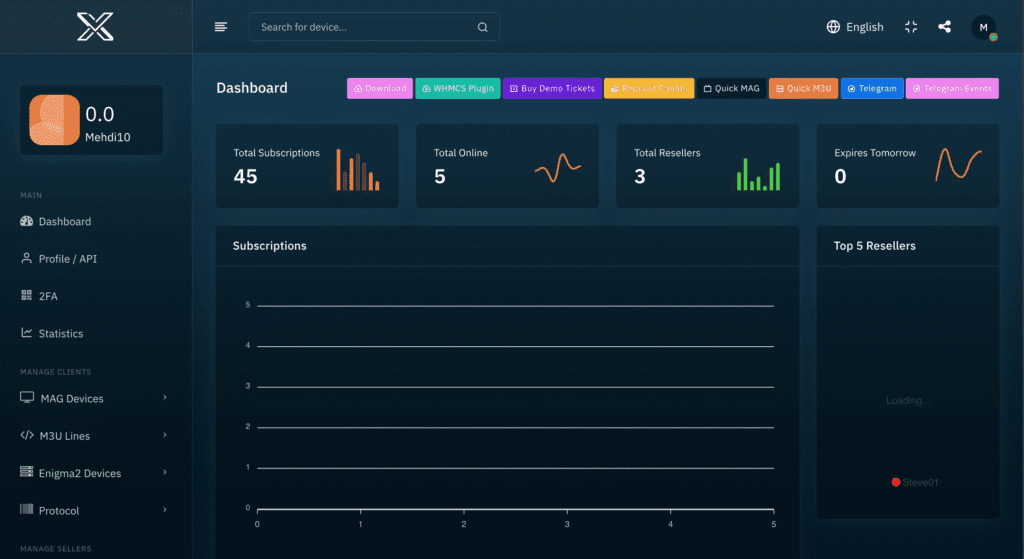
- Trex IPTV: Ultra-premium tier. 49,817 live channels, 184,384 movies, 40,716 series. Entry price: $290 for 120 credits.
- Dino IPTV: Reliable mid-range tier. 20,469 live channels, 98,990 movies, 23,141 series. Entry price: $170 for 120 credits.
Content Library: Quality vs Quantity
Trex carries nearly 50,000 live channels — more than double Dino's 20,000. The difference shows up in niche international content: if your clients want specific regional channels from Southeast Asia, Eastern Europe, or sub-Saharan Africa, Trex is likely to have them. Dino's library covers all mainstream markets (English, French, Arabic, Spanish, Portuguese) comprehensively.
On VOD, both servers offer enormous libraries. Trex has 184,384 movies to Dino's 98,990 — but the reality is most clients will never watch more than a few hundred movies. For practical day-to-day viewing, Dino's library is more than sufficient.
Pricing Comparison for Resellers
The pricing difference is significant and worth thinking through carefully:
- Trex: $290 for 120 credits = $2.42/credit
- Dino: $170 for 120 credits = $1.42/credit
- Difference: $1.00 per credit
At 200 active clients needing 400 credits/month: Trex costs $968/month in credits. Dino costs $568/month. That's a $400/month difference in operating cost — which either goes into your pocket as extra profit or allows you to offer more competitive retail pricing.
What You Can Charge Clients
Because Trex is premium, you can justify higher retail prices. Typical Trex resellers charge $10–$15/month per client. Dino resellers typically charge $6–$10/month. The profit margins are actually similar on a percentage basis — the key difference is your clients' expectations.
Trex clients expect the best. When they pay $12/month they want flawless streams for Champions League, 4K channels, and zero buffering. Dino clients at $7/month are typically happy with solid, reliable performance across mainstream content. Both servers deliver on their promise when running at capacity.
Stability and Uptime
Both Trex and Dino are industry-leading servers with strong uptime records. Trex has an infrastructure advantage during peak events — major football finals, boxing matches, pay-per-view events — where concurrent stream load spikes globally. Dino handles standard daily viewing reliably and performs well even during moderate-traffic events.
For most resellers whose clients watch everyday content — regular football, series, movies, international news — both servers perform at the same level.
Who Should Choose Trex?
- Resellers whose clients are die-hard sports fans who need every possible channel
- Markets where clients have tried other IPTV services and are upgrading for quality
- Resellers who want to charge $10–$15/month and position themselves as premium
- Resellers serving multilingual or niche international communities with specific channel needs
- Experienced resellers scaling up who want the best possible retention rate
Who Should Choose Dino?
- New resellers starting with a tighter budget ($170 vs $290 entry)
- Markets where $6–$8/month is the sweet spot for client acquisition
- Resellers targeting mainstream audiences (not hardcore sports or niche channels)
- Resellers focused on volume — more clients at a slightly lower margin per client
- Anyone who wants to test the IPTV reseller model before committing to premium pricing
Running Both Servers: The Two-Tier Strategy
The two-tier approach is exactly what many top resellers do. Standard plan (Dino): $7/month. Premium plan (Trex): $12/month. Clients self-select based on budget and needs. You maximize both volume (Dino handles price-sensitive clients) and margin (Trex handles premium clients who pay more and churn less).
Both servers come with free 24-hour trials. Test them side-by-side on the same device, same apps, same channels — and see which one performs better for your specific audience. The free trial removes all the guesswork.